
I didn’t notice it happening at first.
There was no single moment when I stopped taking care of myself. It was more like a slow drift. My daughter needed me, and I showed up. The house needed something, and I took care of it. Days passed and somewhere in all of that, I stopped checking in with myself. Not dramatically. Just quietly, and then completely.
That was my experience of matrescence. Not a sudden loss of self. More like a gradual forgetting.
What helped me find my way back wasn’t a perfect routine or a dramatic lifestyle change. It was three small rituals that I kept returning to even on the hardest days. They seemed almost ordinary at the time. But looking back, they carried me through one of the biggest transitions of my life.
The first was the simplest thing I could think of.
Every morning, before I checked my phone, before I thought about what everyone else needed, I took my supplement and drank a full glass of water. That was it. Small enough that even my most exhausted self could say yes to it.
Before motherhood I would have called it a healthy habit and left it at that. After motherhood it became something more. Those few quiet moments became the time I checked in with myself, asked how I was really doing before rushing into another day. One small act that said, before anything else today, I matter too.
I didn’t expect it to do more than that. But over time I noticed it was also pulling me back to my own diwa, my inner self, on the days when everything else felt like noise. The body and the self are more connected than we think.
The second ritual was a walk.
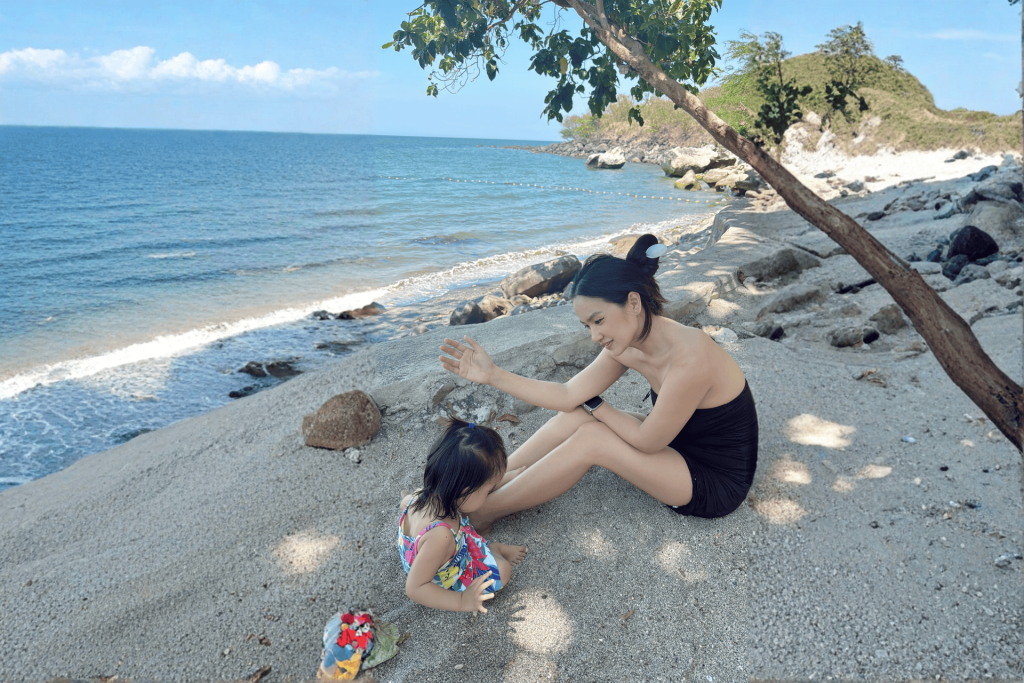
Some days it was twenty minutes. Some days much less. But whenever I could, I took my daughter outside and we just moved through the world together.
I already knew movement was good for me. But this wasn’t really about that. It was about what happened the moment we stepped outside, the way my shoulders came down, my breathing slowed, my thoughts stopped spinning quite so fast. And my daughter beside me, looking at everything as if it was worth noticing, reminding me to do the same.
That walk touched all three roots at once without me even trying. My body moving and my lungs filling was alaga sa katawan. The quiet where my mind could finally settle was alaga sa diwa. And my daughter’s hand in mine, her curiosity pulling me back into the present moment, that was alaga sa kapwa.
It didn’t fix anything. It just brought me back to what was real and what was right in front of me. And on the hardest days, that was enough.
The third ritual started because I was breastfeeding and my body was simply running out.
I was skipping meals, eating whatever was fastest, giving everything I had and not replenishing any of it. And I felt it in ways I couldn’t ignore, less patience, less presence, less of myself available for the people I loved.
So I started eating with more intention. Not following a plan or tracking anything. Just making sure I actually sat down, that the food on my plate was real and nourishing, that I ate it slowly enough to taste it.
What surprised me was how quickly it stopped being about breastfeeding. The plate became another form of alaga sa katawan, a quiet way of saying my body deserves the same care I give to everyone else at this table. Motherhood had already taught me how to nourish my daughter. Alaga taught me to include myself in that same tenderness.
None of these rituals only cared for my body, and I think that’s the point.
The supplement and water reminded me I existed outside my responsibilities. The walk settled my mind and deepened my presence with my daughter. The meal reflected a belief I was slowly, honestly learning to hold: that I was worthy of the same care I gave so freely to others.
At the time I thought I was just building healthier habits. Looking back I was doing something bigger. I was slowly becoming a woman who cared for herself too. A mother who didn’t only give alaga but who learned, little by little, to receive it as well.
This is what Daily Ginhawa looks like in real life. Not a dramatic transformation. Just small rituals, repeated often enough, touching the body, the inner self, and the people we love, until one day you look up and realize they have become part of who you are.
This is what Daily Ginhawa looks like in real life. Not a dramatic transformation. Just small rituals, repeated often enough, touching the body, the inner self, and the people we love, until one day you look up and realize they have become part of who you are.
With love,
Kristen
Start Your Daily Ginhawa
The Ginhawa Starter is a free guide that helps you take one healthy habit and shape it into a small ritual, something that fits your real day and is gentle enough to actually stay.
If you’re craving a little more ginhawa in your everyday, this is a gentle place to begin.
Get Your Free Access →Free. Less than 5 minutes to read.
Curious about my morning ritual?
Many moms ask me about the supplement that’s part of my morning ritual.
If you’re curious too, send me ALAGA on Instagram. I’d be happy to share. 💗
You’ll land in my DMs when you tap.