

For a long time I believed that if I wanted something badly enough, I would just do it. That one good morning with enough motivation would finally make everything click.
So when I kept forgetting the water, skipping the habit, choosing the easier thing and then lying awake thinking about it, I assumed the problem was me. That I just didn’t want it enough.
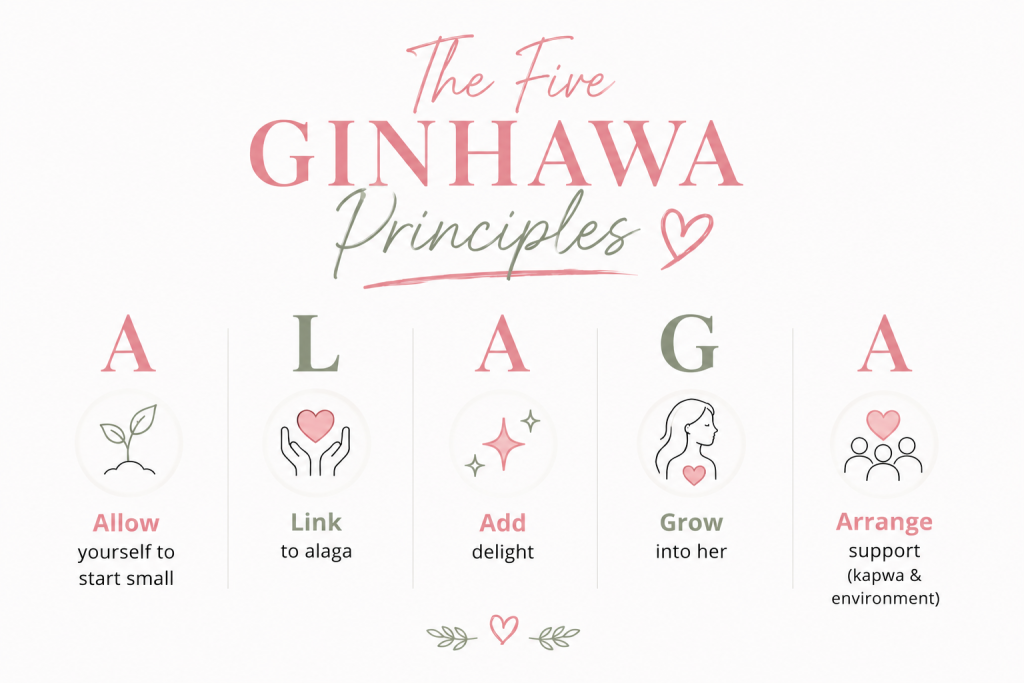
It wasn’t that. The problem was my environment. And that realization became the foundation of the fifth Ginhawa Principle: Arrange Support.
It has two parts: your environment and your people. And I’ve come to believe both matter more than discipline ever will.
There’s a concept called choice architecture and the idea is simple but a little humbling: your environment is already making small decisions for you, all day, whether you set it up that way or not. What’s visible, what’s hidden, what’s easy to reach, what takes three extra steps. These quiet details are nudging your behavior constantly, without you noticing.
Your environment is already choosing for you. The question is just whether you chose it first.
I started making tiny changes in my kitchen. I moved my supplement from inside the cabinet to the counter. I left my journal open on the table instead of tucked on a shelf. I put a glass of water on my nightstand before bed so it was the first thing I saw in the morning.
Nothing about any of that felt significant. But I actually started doing the things.
Not because I suddenly found more discipline. But because I stopped making myself work so hard just to begin. When something is easy to start, you need far less motivation to do it. And that small shift changed everything for me.
And motivation, as every tired mother already knows, is not something you can count on every morning.
So you design for the version of you who didn’t sleep well. Who is already running behind. Who has been needed by three people before she’s had a single quiet moment to herself. You set things up so that she can still show up for herself, even then. That’s not laziness. That’s intention.
But the environment is only half of it.
Because we’re not just shaped by our spaces. We’re shaped by our people.
There’s a Filipino word I keep coming back to: saluhan. It comes from salo, which means to catch what is falling. To receive together. Kapwa saluhan tayo. We catch each other.
I think about the friend who texts me when I’ve gone quiet for too long. The mother who shows up with a big smile when she can tell I’m running low. The women who say me too at exactly the right moment. And I think about my daughter, who reminds me every single day that I am someone’s kapwa too. That the way I show up for myself is also the way I show up for her.
These aren’t small gestures at the edges of my story. They are part of the structure of it.
Having people around us doesn’t just make us feel good. It actually helps us keep going. Not because they cheer us on. But because they remind us of who we’re trying to be. We do better together. Not because we can’t do it alone. But because we were never meant to.
I found that in a community I’m grateful I said yes to. A community growing together in their health, their mindset, and their sense of purpose. That’s what kapwa looks like when it’s actually working.
So this is what the fifth principle is really asking of you.
Look at your environment. Where are you working too hard just to do something good for yourself? Make that easier. Move the thing to the counter. Open the notebook. Fill the glass the night before.
And then look at your people. Not to measure whether they’re enough, but to really see them. They are not a bonus to your healing. They are part of it.
And if that support feels thin right now, if you’re reading this thinking I don’t have people like that, I want you to know that building it is not a side task. Community is not something you earn after you’ve healed. It’s part of how healing happens.
You were never supposed to carry this alone. That was never the design.
The habits you arrange will carry you. The people beside you will carry you further.
The habits you arrange will carry you. The people beside you will carry you further.
With love,
Kristen
Start Your Daily Ginhawa
The Ginhawa Starter is a free guide that helps you take one healthy habit and shape it into a small ritual, something that fits your real day and is gentle enough to actually stay.
If you’re craving a little more ginhawa in your everyday, this is a gentle place to begin.
Get Your Free Access →Free. Less than 5 minutes to read.
Curious About the Community I Found?
I’m part of a community, a lot of them moms like us, where we support each other in keeping ourselves healthy and building financial flexibility.
If that sounds like the kind of people you want around you, send me KAPWA on Instagram. I would love to tell you more.
You’ll land in my DMs when you tap.